Every page, every panel, every idea underneath them — including what we can't tell you and why. If a number on this site ever looks like it came out of nowhere, it's explained in here.
Start here
What this is, and the one rule everything else follows from.
The pitch, in twenty seconds
The figures in the film were pulled from the live API the moment it was rendered. They have moved since — that is the point of them.
If you read one thing: every other screener meets a token the day it lists. We meet it the day it's born, because we read BSC blocks ourselves instead of asking anyone what happened. The rest of this manual is what that buys you.
What StealthX is
A BSC intelligence terminal that reads the chain itself.
Most screeners are a view onto somebody else's data. They ask an API what happened and show you the answer. StealthX runs its own indexer against BSC blocks: it sees a pool the moment it opens, a trade the moment it lands, and liquidity the moment it leaves. Everything on the site is downstream of that, and where we do use an outside source, this manual says so.
That distinction isn't marketing. It decides what we can know. A third-party API can only tell you about tokens it has decided to track, in the shape it decided to publish, at the moment it decided to refresh. Reading blocks means the limit is what happened on-chain, not what someone chose to expose.
Ours, from blocks
Every swap, liquidity add and remove, pair creation, deployer, four.meme curve event, and every launch's bytecode. Candles are built from our own indexed trades and stored, so history survives.
Ours, from our node
Honeypot and exit simulations, owner-power decoding, live pool balances, and each curve's own target read straight out of its contract.
Outside
Price and listing metadata, token logos, and a second-opinion contract check. Named as such wherever they appear.
The rule: when our own on-chain check disagrees with a third party, ours wins. We have caught a third-party check calling a healthy token a honeypot, and calling a token fine while our own simulated sells all reverted. Both directions, same week.
The one thing nobody else has
We meet a token when it's born. Everyone else meets it when it lists.
A large share of BSC memecoins start on four.meme, on a bonding curve inside its token manager. The token exists, people are buying it, and no DEX has heard of it. It only reaches PancakeSwap if the curve fills — and most never do. Anything watching PairCreated sees only the survivors, and meets them at the finish line.
We read the token manager directly, so a curve token is visible from its first block: who minted it, how many distinct wallets bought in, what its shell is, how far it is from its target. By the time a token lands on a DEX and every other screener starts its chart at zero, we already have its whole life.
Everything else in the product is a consequence of that head start. The graduation verdict exists because we watched the curve fill. The shell registry exists because we fingerprinted the contract at birth. The factory alarms exist because we were there before there was anything else to judge.
How to use this manual
In a hurry
Read The concepts. Seven ideas; every page on the site is one of them applied.
Evaluating a token
Skip to How to read it — the order to check things in, a worked example, and the traps.
Wondering about a number
Search the manual, at the top of this page. Every figure the site shows is explained somewhere in here.
Sceptical
Read What we don't know first. It's the honest list of our blind spots, and it's the chapter that should decide whether you trust the rest.
The concepts
Seven ideas. Learn these and every page reads itself.
The shell (bytecode fingerprint)
What the contract is, regardless of what it's called.
We hash every launch's runtime bytecode, stripping the trailing compiler metadata so two copies of one contract match even when they were compiled separately, on different days, by different people. That hash is the token's shell. Names, symbols and logos are costumes; the shell is the body underneath.
This is the only way to see that two unrelated wallets are shipping the same contract. A deployer board groups by wallet and cannot: a rug operation with two wallets looks like two strangers. Grouped by bytecode, they're one.
Every shell gets a class, decided by how concentrated it is — tokens per wallet, not tokens:
Common template
In open circulation: eight or more distinct wallets, or spread thin at roughly a copy each. A launchpad or generator standard — usually ownerless, and no signal about any one token.
Solo factory
One wallet, many copies. Somebody reshipping their own shell under new names.
Shared shell
Two to seven wallets, concentrated at 1.5 copies per wallet or more. A small group reusing one contract — a ring.
Concentration is the signal, not popularity. Forty wallets holding one copy each and two wallets holding one copy each tell the same story: nobody reshipped anything. Past eight distinct wallets a shell is in open circulation and cannot be anyone's private kit — four.meme's standard token sits at hundreds of copies across nearly as many wallets, and calling that a rug ring would condemn most of the chain. We learned this the hard way: an early Factory Floor labelled that exact shell a “shared rug kit”. Twenty-two wallets, one token each, renounced, no owner levers. It was the launchpad's own contract.
The graveyard
“This shell has been used before” is suggestive. “Its pools are all empty” is damning.
Reuse alone proves little — a busy launchpad ships thousands. So for any shell we check what became of what it shipped: every previous token's pool, priced by the quote side's balance, right now.
Alive
$1,000 or more of quote liquidity. Somebody is still in there.
Thin
Between $300 and $1,000. Draining, or never arrived.
Empty
Under $300. Drained or abandoned — for these purposes, dead.
A shell whose last several pools are all empty, whose tokens die within hours, is not a gamble on the next one. It's a rerun. That's what turns a note into a verdict, and it's why reuse alone caps a score at caution while reuse plus a graveyard is danger.
The median age at death matters as much as the death rate. A shell whose tokens reliably die at four hours is running a timer, and that timer predicts your exit window better than any chart.
The curve
A token's life before any DEX exists for it.
A four.meme token raises into a bonding curve until it hits a target written into its own contract at creation. Graduation happens at that target minus a 2% fee. There are two curve types and we read each token's own target out of the manager, per token:
BNB curve
Raises 18 BNB; graduates at 17.64 after the fee.
USD1 curve
Raises 12,000 USD1; graduates at 11,760 after the fee.
We never convert between them and never compare one against the other's finish line — a rule written in blood. An early version took the median of all graduation amounts to find “the” target. The sample was bimodal: a pile at 17.64 and a pile at 11,760. The median described no curve that has ever existed, and every progress bar downstream of it was wrong.
Most curves die at zero. Of the curves we track, the overwhelming majority never get past a few percent; graduation is the exception rather than the path.
The graduation verdict
Who actually filled the curve — the question the DEX can never answer.
When a curve fills, the token lands on PancakeSwap and everyone meets it at once: a fresh chart starting at zero. Two tokens can arrive looking identical and be opposites.
Bought out
Filled in under five minutes by fewer than twenty-five distinct wallets. Nobody had a chance to hear about it — this is someone forcing a listing.
Real demand
Filled over a longer stretch by many distinct wallets. People actually turned up.
Distinct wallets, not trade count — two wallets can make a hundred trades and a hundred wallets can make one each, and only the second is a market. Nothing on the DEX side can ever tell these apart, because the difference happened before the DEX existed for the token. We can, because we watched it.
Pace is measured against the clock, not between the first and last trade. These curves take everything they will ever take in one burst and then sit. Measure between trades and a token nobody has touched in an hour reports as a rocket — silence has to count.
Simulation, not opinion
We don't ask whether you can sell. We try.
Honeypot checks that read a contract's source can be fooled by a contract that behaves differently at runtime — and can't say anything at all about a contract that was never verified. So we simulate real swaps against live reserves on our own node, overriding balances so we can trade tokens we don't hold. What comes back isn't a guess; it's what the chain would do if you pressed the button.
The same technique reads owner powers. Rather than trusting a source file, we scan the runtime bytecode's dispatcher for the function selectors that matter — blacklist, pause, mint, fee and limit setters. Unverified contracts have no hiding place.
Discovery
Nobody hands us a token list. The market discovers itself.
Every few minutes we sweep the chain's swap traffic with no address filter — every swap in the window, whoever it belongs to — count them by pool, and admit the busiest into the index. A token earns its place by being traded, not by being listed somewhere we subscribe to.
Pools quoted on both sides (WBNB/USDT and friends) are dropped. They are the busiest pools on the chain and they tell you nothing about any token, so they would win the sweep every time and crowd out everything worth seeing.
Discovery never runs at the expense of keeping up. The sweep is gated on how far behind the head we are and stands down when the indexer is lagging — a rule that exists because a sweep once ran inside the block loop and put the indexer seven thousand blocks behind the chain.
The trending model
Momentum, adjusted for the fact that momentum is trivially faked.
Trending scores growth over 24 hours across four axes — volume, trade count, distinct traders and liquidity — then weights the result by absolute size. The weighting is the whole point: growth alone is a percentage, and a token that went from nothing to almost nothing has spectacular percentages. Without a size term the board fills with dust.
Trending
Growth × size, over 24h. The default board.
New & Rising
The same model with a sharper age curve, so fresh launches can compete with established pools.
Top Pairs
Absolute 24h volume and traders. No growth term at all — just size.
Distinct traders carries more weight than trade count, for the reason it always does: trade count is what a bot produces for free, and distinct wallets cost money to fake.
Every page
What each one shows, where the data comes from, and how to read it.
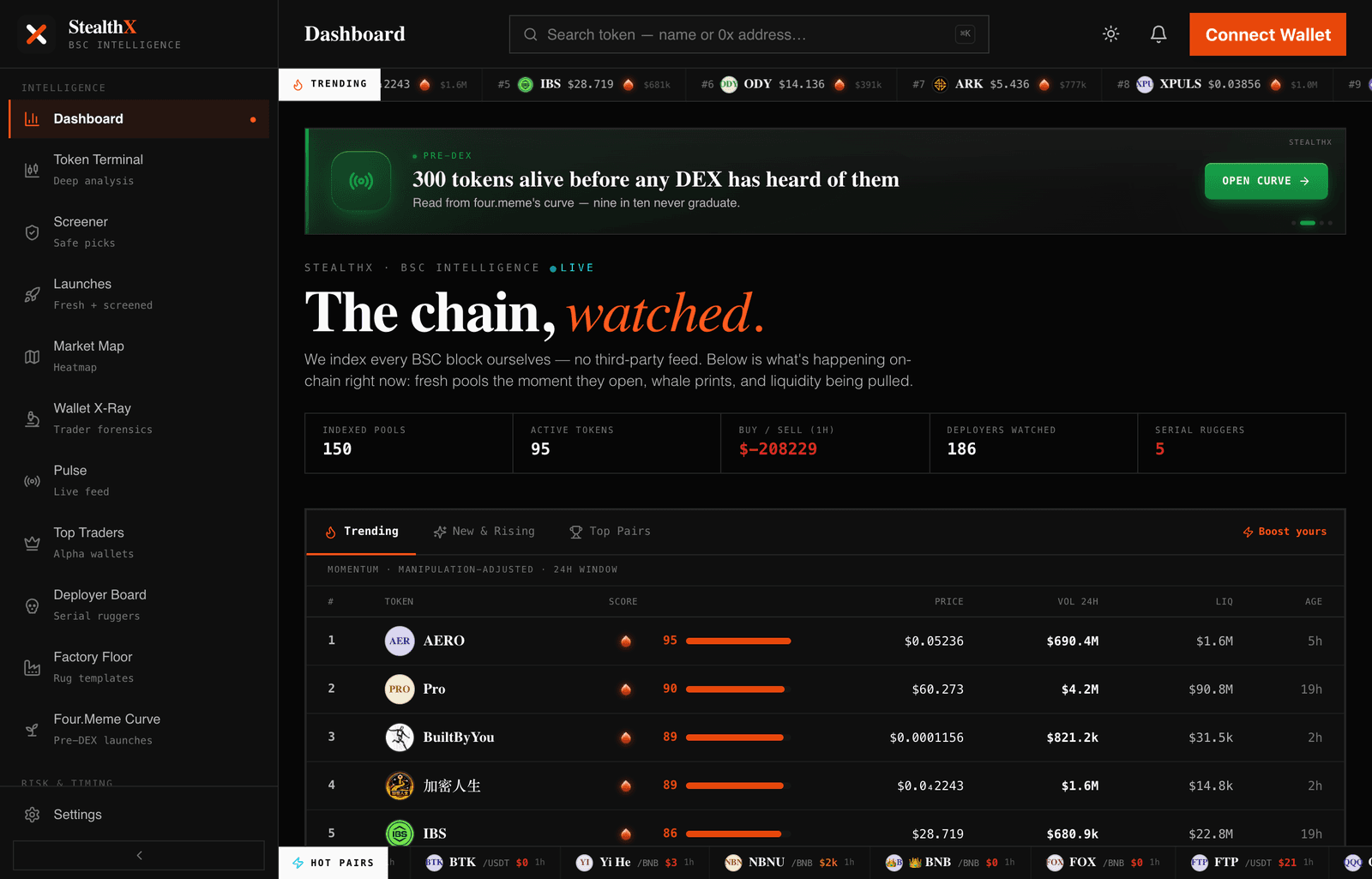
Dashboard
The market as our index sees it.
01The counters across the top are the index's own vitals, not market stats: pools swept every block, tokens with activity, the last hour's net buy/sell flow, deployers on file, and how many are serial ruggers.
02The banner rotates through live figures queried from the index itself. If it claims a number, that number came from a query a minute ago.
03The board's tabs are the three models described in The trending model — growth×size, the same with a sharper age curve, and raw size.
04Ticker rails top and bottom: trending, and the hottest pairs by recent flow.
The dashboard is the only page that describes the tool rather than a token. When the numbers along the top move, that's the indexer's coverage changing — new pools admitted by discovery, new deployers seen, new shells fingerprinted.
Token Terminal
One address, everything we know. Documented panel by panel in the next chapter.
Paste an address or arrive from any link. Nine panels, each a different way of asking whether this token is what it says it is; the next chapter takes them one at a time.
If the outside world has never heard of the token — because it's dead, rugged, or still pre-DEX — the page doesn't give up. Price is gone, but the chain still tells us who shipped it, what it can do, and what its shell has done elsewhere. That's exactly when you want it most, and exactly when every other screener shows you a 404.
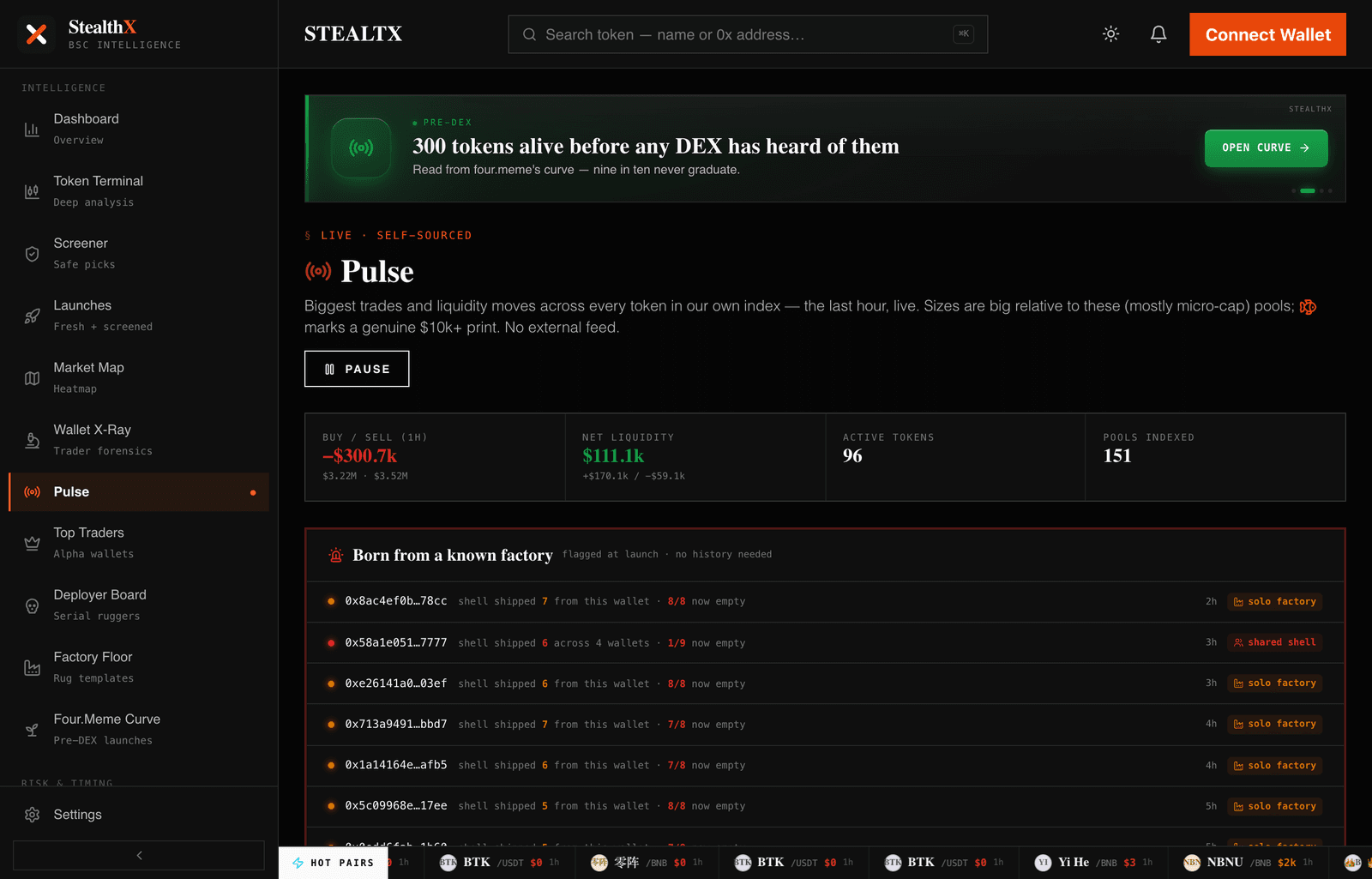
Pulse
The whole index, live.
01Factory alarms sit above the trades, deliberately. A trade is about a token that already exists and can wait; an alarm fires before a token has a chart, a holder or a single trade to judge, and stops mattering within minutes.
02The trade feed is every significant swap across the whole index — not one token.
03Liquidity events are split out from trades, because an add and a remove are the two things that decide whether any of the rest matters.
An alarm at birth is the earliest warning the product can produce. It says: this contract is byte-identical to a shell whose pools are already empty — and it says it before there is anything else about the token to look at.
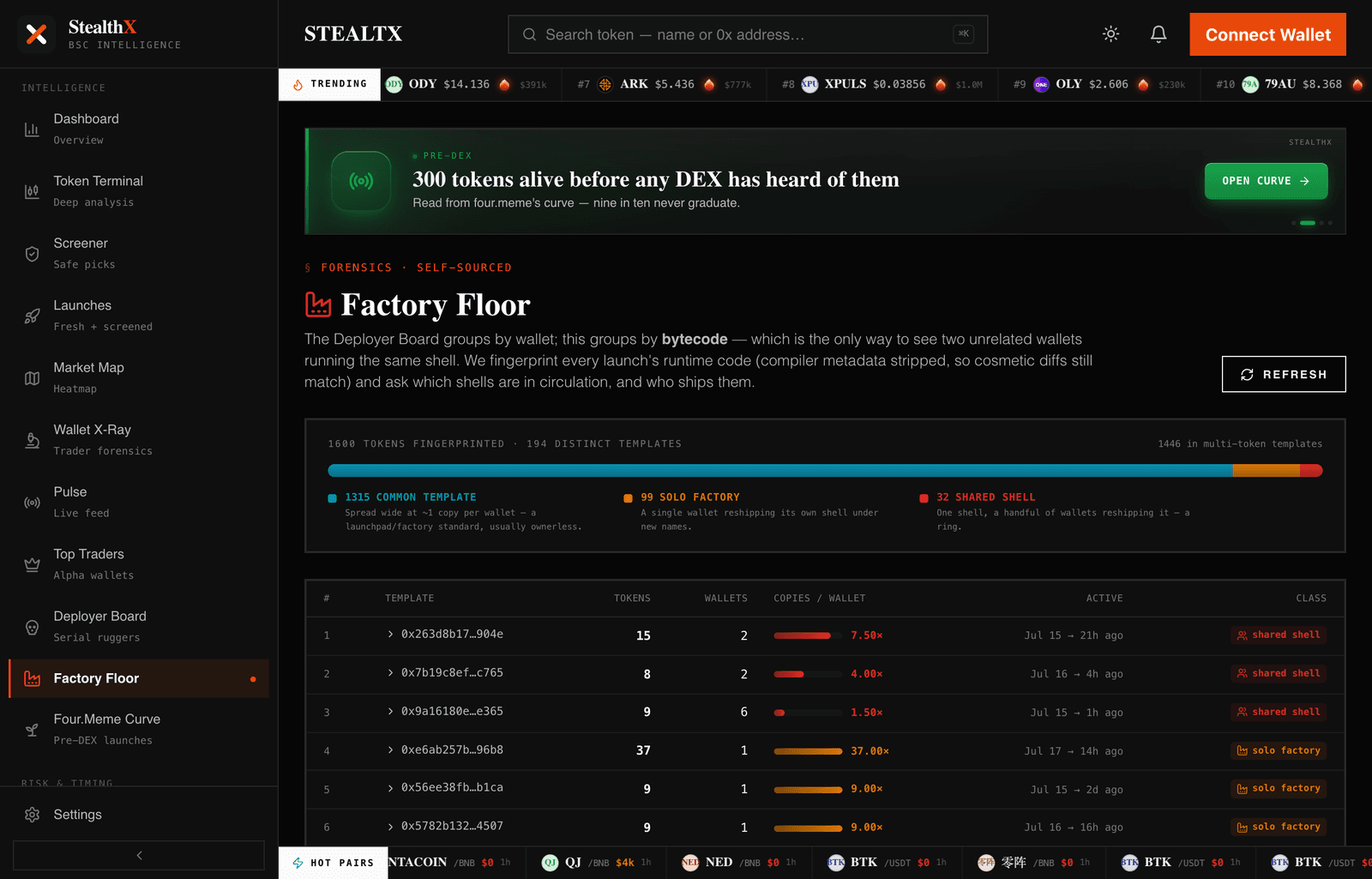
Factory Floor
Which shells are in circulation, and who ships them.
01The composition bar splits the whole registry into the three classes. Common dominates by a mile — and that's the healthy shape, because most shells really are launchpad standards.
02Rows are ranked by copies per wallet, not by size. A launchpad standard with hundreds of copies is the least interesting row on this page, so the page opens on the finds instead.
03The copies/wallet column is the whole argument. A 37× bar on a single wallet is a production line. A 1.5× bar across six wallets is a ring sitting right at the edge of the definition.
04Class badges follow the thresholds in The shell — they're computed, not assigned by hand.
05Expand any row for the wallets running that shell, everything it shipped, and how much of it is already empty.
The Deployer Board groups by wallet; this groups by bytecode. That's the only way to see two unrelated wallets running the same shell, and it's the page that exists purely because of the fingerprint.
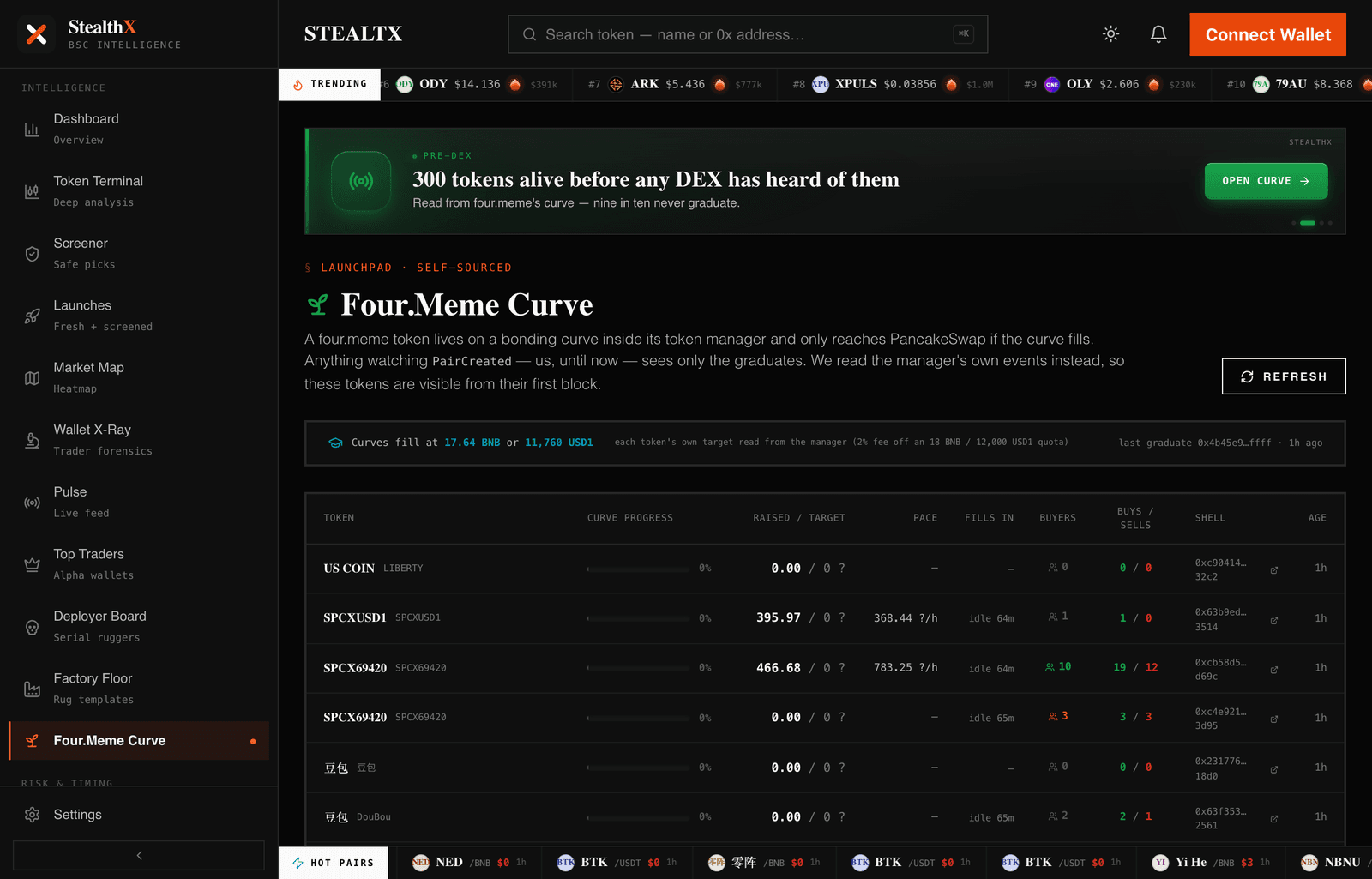
Four.Meme Curve
Tokens that exist, and don't exist to any DEX.
01Every token here is invisible to every DEX-based screener on the internet, right now, by construction.
02Progress is measured against each token's own target in its own unit — a BNB curve against 17.64, a USD1 curve against 11,760. The quote symbol is shown because the comparison is meaningless without it.
03Distinct buyers is the column that matters. Buys and sells can be two wallets in a loop.
04The shell class is carried through from the registry, so a curve token is already classified before it has a price.
05Idle time is shown because these curves fill in bursts and then sit. A high rate with a long idle gap is a finished story, not a live one.
Read straight from the token manager's own events. When one of these graduates it becomes a PancakeSwap listing that everyone else is meeting for the first time — and we hand you its entire history in the same moment.
Screener
Safe picks, with our registry holding a veto.
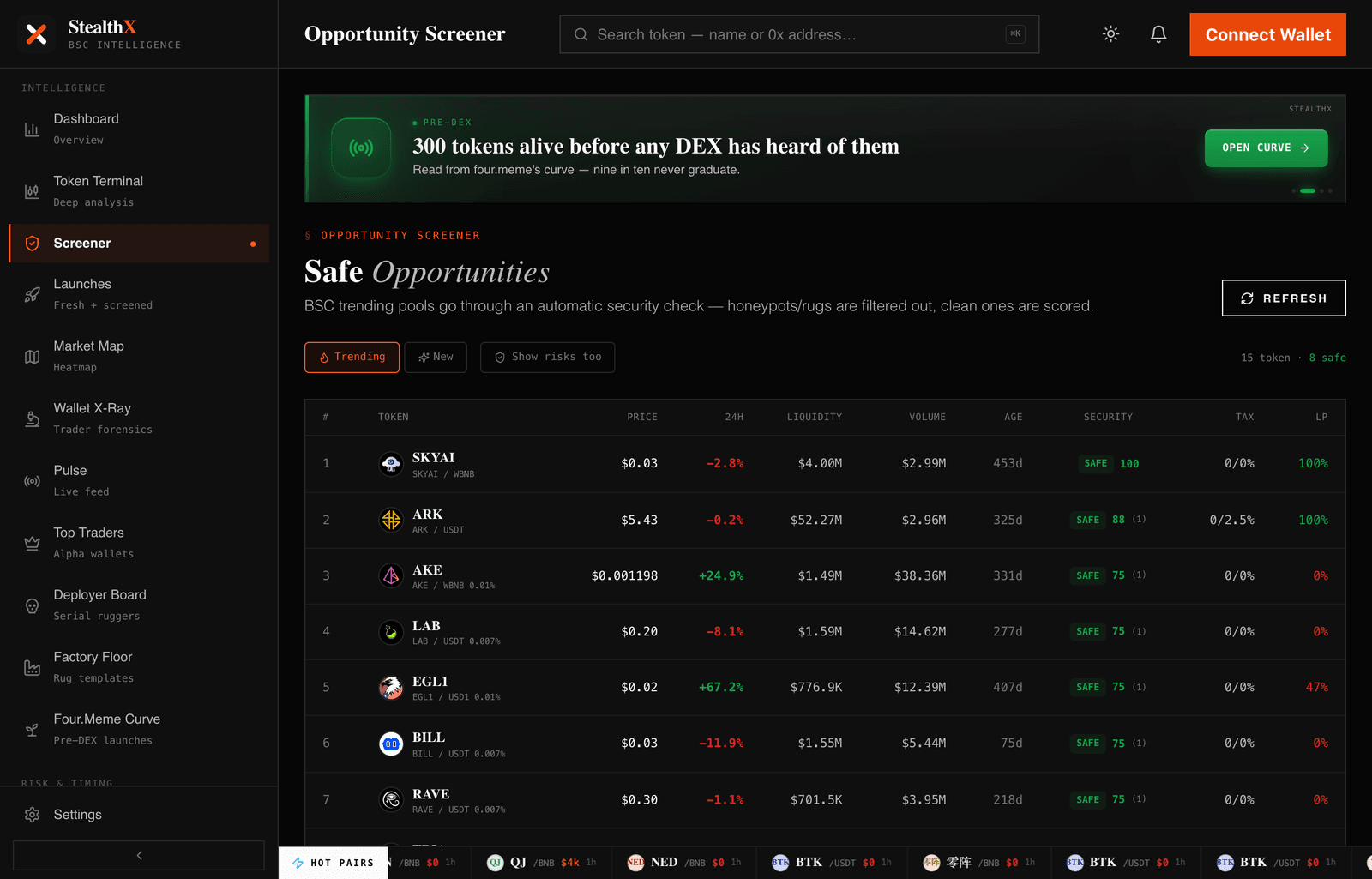
01Every row has passed a per-token security check: taxes, LP custody, owner share, and the usual contract levers.
02The security column shows the score and, in brackets, how many flags survived. Green is not the same as flawless.
03The LP column is custody, not size — what share is burned or locked and therefore can't be pulled out from under you.
04Tax is shown as buy/sell. The sell number is the one that decides whether you get out with anything.
That per-token check reads each token in isolation — which is exactly the blind spot a template rug is built for. A shell can pass every one of those checks and still be the eighth copy of one a wallet has drained seven times, because nothing about the eighth copy is different. Nothing about it needs to be.
Shell reused
Score capped at caution, whatever the contract checks say.
Shell reused, pools empty
Score capped at danger. The graveyard overrides a clean bill of health.
Common template
No veto. A launchpad standard is not evidence about anything.
Deployer Board
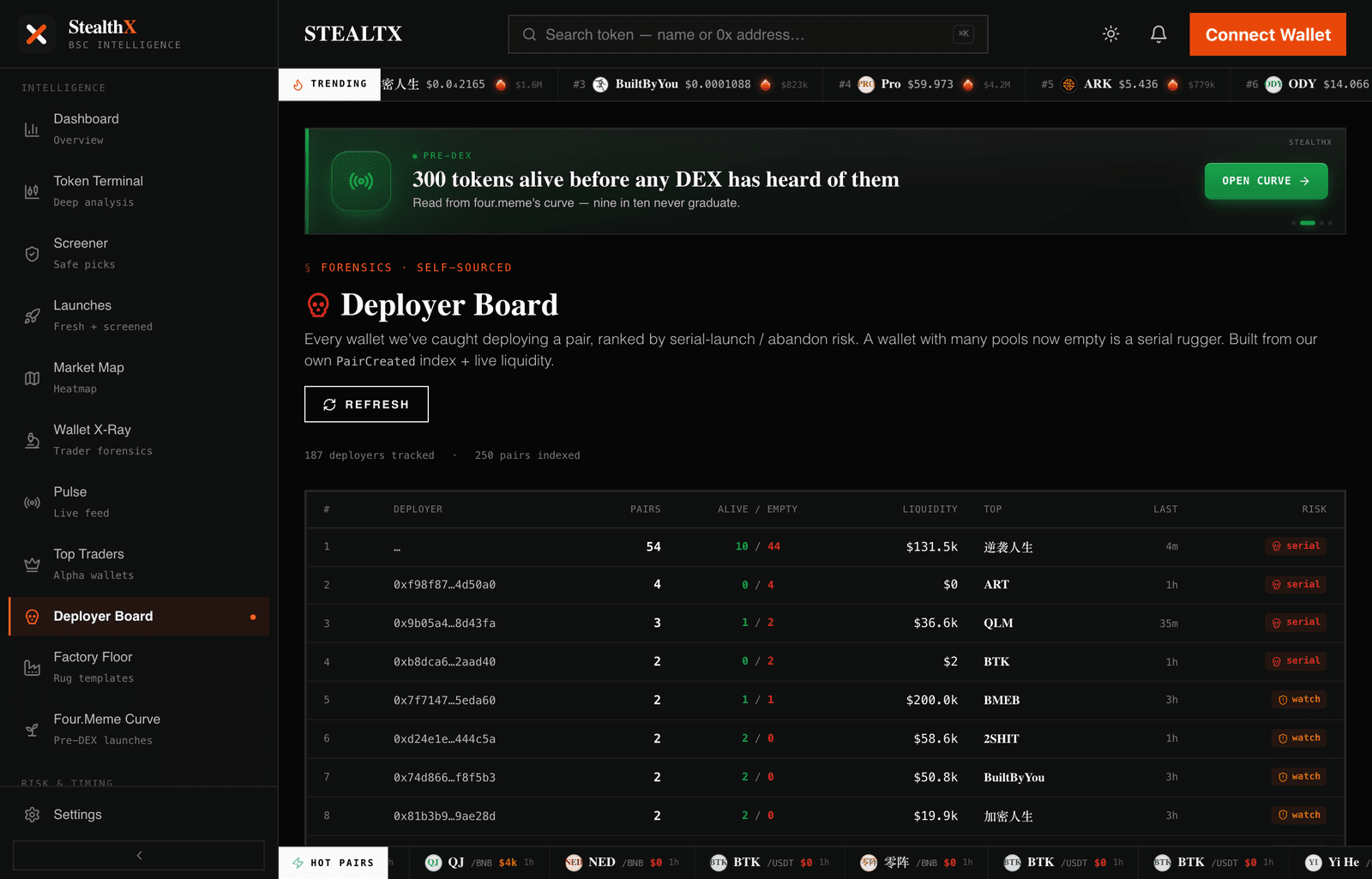
Every wallet we've caught deploying a pair, ranked by abandonment.
01Built from our own pair-creation index plus live pool liquidity — the wallet that created the pair, and what happened to everything it created.
02The alive/thin/empty split uses the same $1k and $300 lines as the graveyard.
03A wallet with many pools, nearly all empty, is a serial rugger. That's not an accusation, it's a count.
04This page groups by wallet, so a two-wallet ring appears twice, as strangers. The Factory Floor is where that ring becomes one row.
The rest
Launches
Fresh pairs the moment they open, already screened.
Market Map
The board as a scatter: risk against momentum, sized by liquidity. For seeing the shape of a market rather than a ranking.
Wallet X-Ray
Trader forensics — what a wallet actually did, not what it says.
Top Traders
Wallets that consistently got in early and out well, scored across our whole index.
Trust Score
Safety signals for a token, aggregated into one page.
Holder Health
Distribution: bots, shrimp, fish, whales, and how fast holders leave.
Trend Score
The momentum model for a single token, with its components exposed.
Launch Timing
The market clock — when the chain is actually awake.
Exit Strategy
Planning the way out before you need it.
Alerts
Price and risk notifications on a watchlist.
Portfolio
Your wallet's holdings and history.
Compare / Battle / Tournament
Tokens side by side, one on one, or bracketed.
Alpha Tracker
Distance from Binance Alpha's listing criteria, tracked daily.
Sniper Radar
Who bought the launch, and how coordinated they were.
Degen Profile
Your rank and badges.
Promote
Paid placement — see Promotion below.
Two entries in the sidebar aren't part of the product. Launch (StealthBundler) is unfinished. Organic Engine and its anti-detection machinery are disabled and stay that way — the code exists; the feature does not.
The Token Terminal, panel by panel
Nine reads on one address. This is where the whole product lands.
StealthX Verdict
One letter grade, and the reasons under it.
Fuses everything below into a grade, and shows you every flag that moved it. It is not a black box: each red and green line is a claim you can go check on the panel it came from.
Precedence matters more than arithmetic here. Anything we established on our own node outranks a third party, in this order:
01The exit ladder. If no size can sell, that's the answer and nothing overrides it.
02The honeypot simulation. A reverting sell ends the grade on the spot.
03The shell registry's veto — reuse caps at caution, a graveyard caps at danger.
04Only if none of our own tests reached a verdict does the third-party check get to speak.
Honeypot simulation
We buy, then we try to sell. On our node, with real reserves.
A real swap, simulated against live state. If the sell reverts, you cannot exit and the grade dies on the spot. If it clears, you get the effective tax — the number that actually came back, not the one the contract advertises.
Advertised tax and effective tax are different numbers, and the gap between them is where the money goes. Trust the one we measured.
Exit pressure test
Five sells, from small to large.
A single-size honeypot check misses the two most common traps: a max-sell limit that only bites above a threshold, and a tax that escalates with size. Both let a small test sell sail through while your actual position is stuck. So we simulate selling at five positions and report where it starts to revert. Green clears cheap; red reverts.
Read it as your real exit window. If the ladder goes green-green-red-red-red, you can leave with a small bag and not a large one — which means the position you're considering may already be too big before you've opened it.
“Sells revert at every size” has two causes: the code blocks selling, or the pool has already been drained to nothing. Different stories, same fact for you — there's no way out.
Owner powers
What the owner could still do to you, decoded from bytecode.
We read the runtime bytecode — which works even when the contract was never verified — and scan its dispatcher for known levers: blacklist, pause, mint, fee and limit setters.
The honeypot test says what happens now; this says what could happen later. A token that simulates perfectly and has a live blacklist function is a token that is fine until the owner decides it isn't. Renounced ownership is what turns this panel quiet.
The Shell
What this contract is, and what its siblings did.
The registry's read on this token: its shell's class, how many copies exist and across how many wallets, and — the part that decides it — how many of those siblings' pools are already empty, with their median age at death.
Keyed on bytecode alone, so it answers even when we don't know the deployer, and it answers the second the token exists. Unlike price, holders, or even our own sell test, this panel needs no history from the token itself — only from its family. It is the only thing on the page that can warn you about a token that is thirty seconds old.
Rug DNA
How many times has this exact wallet shipped this exact contract?
Walks every other token the deployer launched in our index and fingerprints them. Rug factories reship one template under new names; real projects don't. A wallet whose launches are byte-identical to each other is running a production line, and the current token is the next unit off it.
Where The Shell asks “what is this contract, and who else uses it”, this asks “what does this person do for a living”. Both can fire on the same token; either alone is enough to matter.
Life before the DEX
For a four.meme token: everything that happened before anyone could see it.
When it was minted and by whom, how many distinct wallets bought in on the curve, how long the curve took, and what it raised against its own target.
Worth most in the minutes right after graduation — which is exactly when the DEX side has nothing to say, because the chart is four candles long. This panel is the difference between “new token, who knows” and “filled by six wallets in ninety seconds, and here they are”.
And the rest of the page
Price
Candles built from our own indexed trades and stored, so history survives. Falls back to backfilling on demand when a window is thin.
Activity
Volume, buys, sells and buy pressure across five windows, so you can see whether a move is accelerating or already over.
Trend Score
Where this token sits in the momentum model, with its components broken out.
Smart money
Whether wallets with a track record across our index are in this one — and whether they're still here.
Early buyers
Who got in first, and what they've done since.
Coordination
Whether the early buyers moved as a group. Independent wallets don't buy in the same block.
MEV
Sandwiches detected against this token — a tax you pay without seeing it.
Liquidity safety
LP custody: burned, locked, or free to pull.
Liquidity activity
Every add and remove, in order.
Holder concentration
Top-10 share, whales, and how much supply sits in contracts rather than wallets.
Time Machine
What a buy at any past moment would be worth now.
Ask
Plain questions about the token, answered from the panels above.
How to read it
The habits that make the difference.
Read in this order
01Can you get out? Exit pressure test first. If no size clears, nothing else on the page matters and you're done.
02What can the owner still do? Owner powers. A clean token with a live mint function is not a clean token.
03Has this contract done this before? The Shell — and specifically whether its siblings' pools are empty.
04Who filled it? For a four.meme graduate: five wallets in a minute is not a market, however the chart looks.
05Is anyone real in here? Distinct traders, holder concentration, coordination.
06Only then: price and momentum. They're the first thing every other tool shows you and the last thing that should decide anything.
A worked example
The same token, read badly and read well.
A token appears on the trending board. It's up 236% in an hour, the chart is a staircase, and the third-party security check is green. The naive read: momentum plus a clean bill of health.
The manual's order says otherwise. Exit ladder: green at the smallest size, red at the other four — so the 236% is real and unreachable. The Shell: byte-identical to a shell with eleven previous tokens, nine of them in pools now under $300, median death at four hours. Life before the DEX: the curve filled in ninety seconds across six distinct wallets.
None of that contradicts the green check, and that's the point — the check read the token alone, and the token alone is fine. Every fact that condemns it lives in its family, its curve, and our own sell test. The chart was the only honest thing on the page and it was still useless.
Things that look like signals and aren't
A popular shell
Hundreds of tokens sharing one contract is a launchpad standard — usually ownerless, and often safer than a bespoke contract. Concentration indicts; popularity doesn't.
A big number with no size
A token that went from $0 to $375 has infinite growth and no market. Trending weights absolute size for exactly this reason.
Trade count
Two wallets can make eighty trades. Distinct buyers is the number that means something.
A green third-party check
It reads the token alone. It cannot see that the same contract has been drained seven times already.
A pumping chart with no liquidity
+236% means nothing if the pool holds $0.07. Check that you can sell before you check anything else.
Advertised tax
The contract's stated tax and the tax you actually pay are different numbers. Ours is measured.
A fast curve
Speed with few distinct buyers is someone forcing a listing, not demand. Fast is the warning, not the feature.
Under the hood
Why the numbers move, and what's running.
What's actually running
The indexer
Follows BSC's head — roughly a block every 0.75 seconds — decoding swaps, liquidity events and pair creations as they land.
Discovery
Sweeps unfiltered swap traffic every few minutes and admits the busiest pools. Stands down whenever the indexer is behind.
The registry
Fingerprints each launch's bytecode, classifies the shell, and re-checks its siblings' pools.
The curve reader
Polls four.meme's token manager, decodes its events, and reads each token's own target.
The node
Runs every simulation: honeypot, exit ladder, owner powers, live balances.
Why a number changed
Counts on this site go up as we index more, and they can go down: a pool that drains stops being alive, and a token that dies leaves the active set. Neither is a bug. The registry's totals in particular grow every block, which is why this manual describes them rather than quoting them.
Simulations are point-in-time. An exit ladder that was green an hour ago is not a promise about now, because reserves move and owners act. Re-run it before you rely on it.
Promotion
What's for sale, and what isn't.
Boosts and banners
You can pay in BNB to lift a token in Trending or take the banner slot. Payment is verified on-chain and the placement goes live the moment it confirms. Boosts are a multiplier on the score, not a replacement for it, and a boosted row is always labelled as one.
Paying does not buy a verdict. A boosted token carries the same flags as any other, and the screener's veto doesn't care who paid. If we'd call it a rug for free, we'll call it a rug for money.
What we don't know
The limits, stated plainly, because a tool that hides them is worse than one that has them.
Limits
01We know what we've indexed. A token that launched before we started watching has no history with us, and its numbers will look thin until it earns some.
02The registry only recognises a shell it has seen twice. The first copy of a brand-new template looks innocent, because to us it is.
03A launchpad standard tells you nothing about a specific token — good or bad. Absence of a shell flag is not a clean bill of health.
04Simulation reflects the chain as it is right now. An owner with a live lever can change that after you buy, which is exactly what Owner powers is for and exactly what it can't predict.
05The graduation verdict needs a curve to read. A token that reached a DEX some other way has no verdict — not a good one.
06Prices, logos and listing data come from outside sources. When they disagree with our own checks, our own checks win — and this manual says which is which.
07The screenshots in here are captures from a real session, frozen at capture time. The layout is current; the tokens in them are whatever happened to be trading that day.
08None of this is advice, and none of it is a guarantee. It's evidence. DYOR.